
Qubit Location Intelligence
Know where to open your next branch.
Compare candidate sites using demand, mobility, demographics, competition, property prices, and drive time. Then test how a new branch could affect sales at your existing locations before you invest.
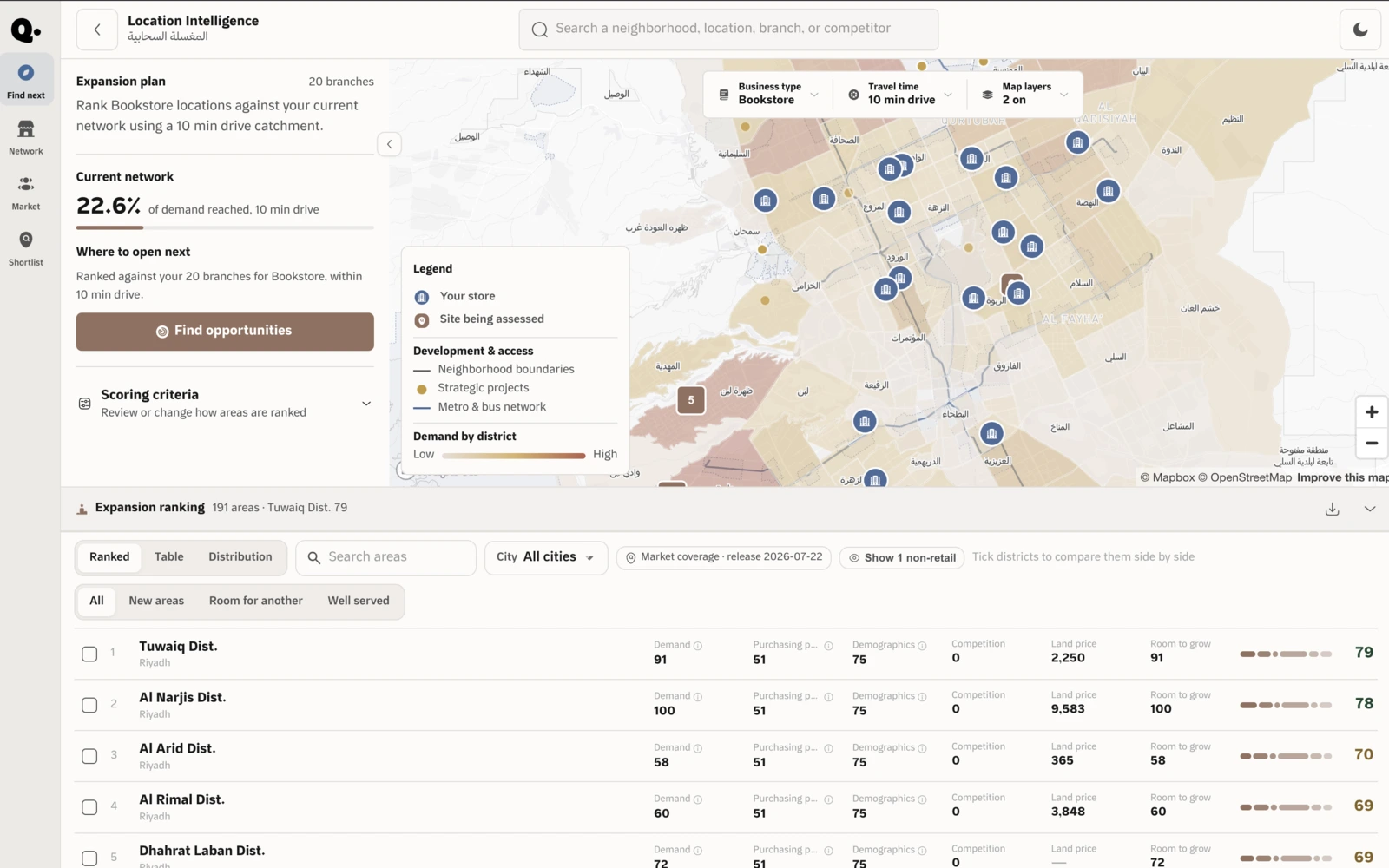
Areas with underserved demand
Sites ranked by commercial opportunity
Branch overlap and cannibalisation analysis
Every scenario keeps its assumptions
Compare a site against the network it will join.
Qubit combines your branch performance with demand, access, competition, property, and mobility signals. Every score can be opened, challenged, and compared before the lease decision.
Location Intelligence, Expansion
Illustrative scenario
Candidate A
Candidate B
Candidate C
Current comparison
Candidate B
Strong uncovered demand and access, with manageable overlap against the current portfolio.
Demand fit
88%
Drive-time access
76%
Portfolio overlap
64%
Format fit
81%
Shortlist for field diligence
Six data layers on one map.
Qubit brings the base map together with demand, population, spending, competition, property, and travel-time reach. Open each layer on its own or read them together to understand why a site scored higher or lower.
Travel-time reach
Population and spending
Competition
Demand
Property
Base map
Site score, network impact, and evidence for approval.
A promising neighbourhood can still be the wrong site if it overlaps a strong branch or serves the wrong catchment.
Demand and market layers
Compare spending, population, daytime activity, competition, and relevant commercial signals across candidate areas.
Drive-time catchments
Model realistic access by travel time and road network instead of relying on simple distance circles.
Portfolio overlap and scenarios
Test how a candidate may add coverage, relieve capacity, or cannibalise existing locations before signing a lease.
Performance-calibrated scoring
Calibrate site scores against the results of your current network so demand, competition, access, and format assumptions stay tied to observed performance.
Candidate comparison workspace
Review shortlisted sites side by side, change a weight or assumption, and see which part of the recommendation moved.
Expansion briefs and approvals
Publish the map, catchment, score, assumptions, and next diligence step as one reviewable decision pack.
Location decisions with visible assumptions.
Bring the internal performance and external market layers into the same model before you commit capital or reshape the network.
New-site selection
Rank candidate sites by demand, access, competition, property context, and fit with the operating model you already know.
Network optimisation
See catchment overlap, customer movement, underserved demand, and the likely portfolio effect of opening, moving, or closing a site.
Scenario planning
Change assumptions, compare options, and retain the source layers and scoring logic behind every recommendation.
Define the format, assemble the layers, compare the sites, record the decision.
Start with the business format and expansion target, then compare every candidate against the same evidence.
Define the format
Set the customer, category, footprint, operating model, and performance target for the site.
Assemble the layers
Combine internal branch data with demand, competition, catchment, and property context.
Score and compare
Rank candidates and inspect why each site gained or lost points.
Record the decision
Publish the map, assumptions, evidence, and recommended next diligence step.
Every score keeps its layer sources and scenario assumptions.
Location models stay useful when their source layers, scoring logic, and scenario assumptions remain visible.
Source provenance
Keep the provider, date, geography, and transformation behind every market layer.
Role-based portfolio access
Limit internal branch, customer, and commercial performance to the teams authorised to use it.
Scenario history
Retain candidate inputs, weights, assumptions, and outcomes so decisions can be revisited.
Saudi processing
Process operational and customer-linked analysis within the approved Saudi deployment boundary.
Explore more Qubit products.
Connections, identity, model controls, and audit are shared across the Qubit portfolio.
Compare the expansion sites on your shortlist.
We will show how Qubit combines your network performance with Saudi market layers, compares the candidates, and keeps the assumptions visible for the investment team.